Les étudiants doivent suivre cinq cours parmi la liste des cours fondamentaux et spécialisés. Les règles suivantes s'appliquent :
1) Les étudiants doivent choisir un ou deux cours dans la liste des cours fondamentaux dans la filière de leur choix.
2) Les étudiants de la filière EPAP, EUW et EUN doivent choisir un ou deux cours parmi la liste des cours fondamentaux et/ou des cours spécialisés de la filière EHC. |
Cours fondamentaux- LANNON, E. – The EU and its Southern Neighbourhoods (20h, 4 ECTS)
- ŁAZOWSKI, A. – Enlargement Policy of the European Union (20h, 4 ECTS)
- SCHUMACHER, T. – Whither Neighbourhood? The EU, Eastern Europe, and the Southern Mediterranean in Times of Peace and War (20h, 4 ECTS)
- WOLCZUK, K. – The EU and Eastern Europe (20h, 4 ECTS)
|
Cours spécialisés - AYDIN, M. – Turkey Between Europe and Eurasia: Historical and Contemporary Evaluation (20h, 4 ECTS)
- BUZOGANY, A. – EU Energy Governance in the EU’s Neighbourhood (20h, 4 ECTS)
- CASSARINO, J.-P. & DAVITTI, D. – Cooperation on Migration Governance between the EU and its Neighbourhood (20h, 4 ECTS)
- CASTELLINO, J. & CAVANAUGH, K. – Minority Issues, Nationalism and Identity Politics in the EU’s Neighbourhood (20h, 4 ECTS)
- DEMMELHUBER, T. – Autocratization in the Middle East and North Africa (20h, 4 ECTS)
- HILLION, C. – The EU’s Relation(s) with a Wider Europe – The Legal Dimension (20h, 4 ECTS)
- KALENSKÝ, J. – The EU and the Geopolitics of Disinformation and Digital Communication in the Neighbourhood and Russia (20h, 4 ECTS)
- LANOSZKA, A. – War and Conflict in the Post-Soviet Space (20h, 4 ECTS)
- MAYR-HARTING, T. – The European Union and Bi- and Multilateral Diplomacy (20h, 4 ECTS)
- ONUCH, O. – Revolutions and Mass Mobilization in Eastern Europe (20h, 4 ECTS)
- ROUSSELET, K. & SHEIKH, N. – Church-State Relations and the Role of Religious Movements in the EU’s Neighbourhood / Les relations Eglises-Etat et le rôle des mouvements religieux dans les pays voisins de l’Union européenne (20h, 4 ECTS)
- TEOKAREVIC, J. – Western Balkans: EU Enlargement, External Influences, Post-Conflict Transition (20h, 4 ECTS)
- TYUSHKA, A. – The EU, Russia and the EU's Eastern Neighbourhood: Power, Performance, and Perceptions (20h, 4 ECTS)
|
Colloque de recherche du mémoireLes étudiants sont automatiquement inscrits au colloque de recherche du mémoire. - ŁAZOWSKI, A., WOLCZUK, K., TYUSHKA, A., HAMMAMI A. – The EU in the Wider Europe and its Neighbours Research Colloquium
|
Séminaires intensifsLes étudiants doivent choisir deux séminaires intensifs. - AL-SABBAGH, R. – Investigative Journalism in the Southern Neighbourhood (8h, 0 ECTS)
- BOURIS, D. – EU-Middle East Relations: Conflict, Peace and Security (10h, 0 ECTS)
- BUSCHLE, D. – The Energy and Climate Transition in the European Union’s Neighbourhood – A Policy Lab on Eastern Europe and the Western Balkans (10h, 0 ECTS)
- CHABAN, N. – External Perceptions of the EU and EU Public Diplomacy: Views from the EU’s Neighbourhoods and around the World (10h, 0 ECTS)
- FRANZA, L. – Energy Security and Conflict in the EU’s Southern Neighbourhood (10h, 0 ECTS)
- ISAACS, R. – Central Asia as the EU's Wider Neighbourhood: Power, Politics, and Foreign Policy (10h, 0 ECTS)
- SHAGINA, M. – Sanctions and Economic Statecraft (10h, 0 ECTS)
|
Jeux de simulationLa participation aux jeux de simulation est facultative. |
Coopération avec des partenaires extérieursLes étudiants peuvent choisir n'importe quel nombre des éléments suivants. |
Développement professionelL’offre d’engagement étudiant et de renforcement des capacités complète le programme académique par un accompagnement et des conseils personnalisés, fournis sur place, afin d’aider les étudiants à définir leur parcours professionnel. |
Cours de languesEn plus de bénéficier d'un programme d'études bilingue, les étudiants peuvent bénéficier de cours de langues proposés par le Bureau des langues et du dialogue interculturel. Les langues suivantes sont proposées : anglais, français, italien, allemand, polonais, russe, espagnol et arabe. Les cours sont adaptés aux besoins individuels des étudiants et sont également axés sur les compétences transversales requises par les employeurs. |
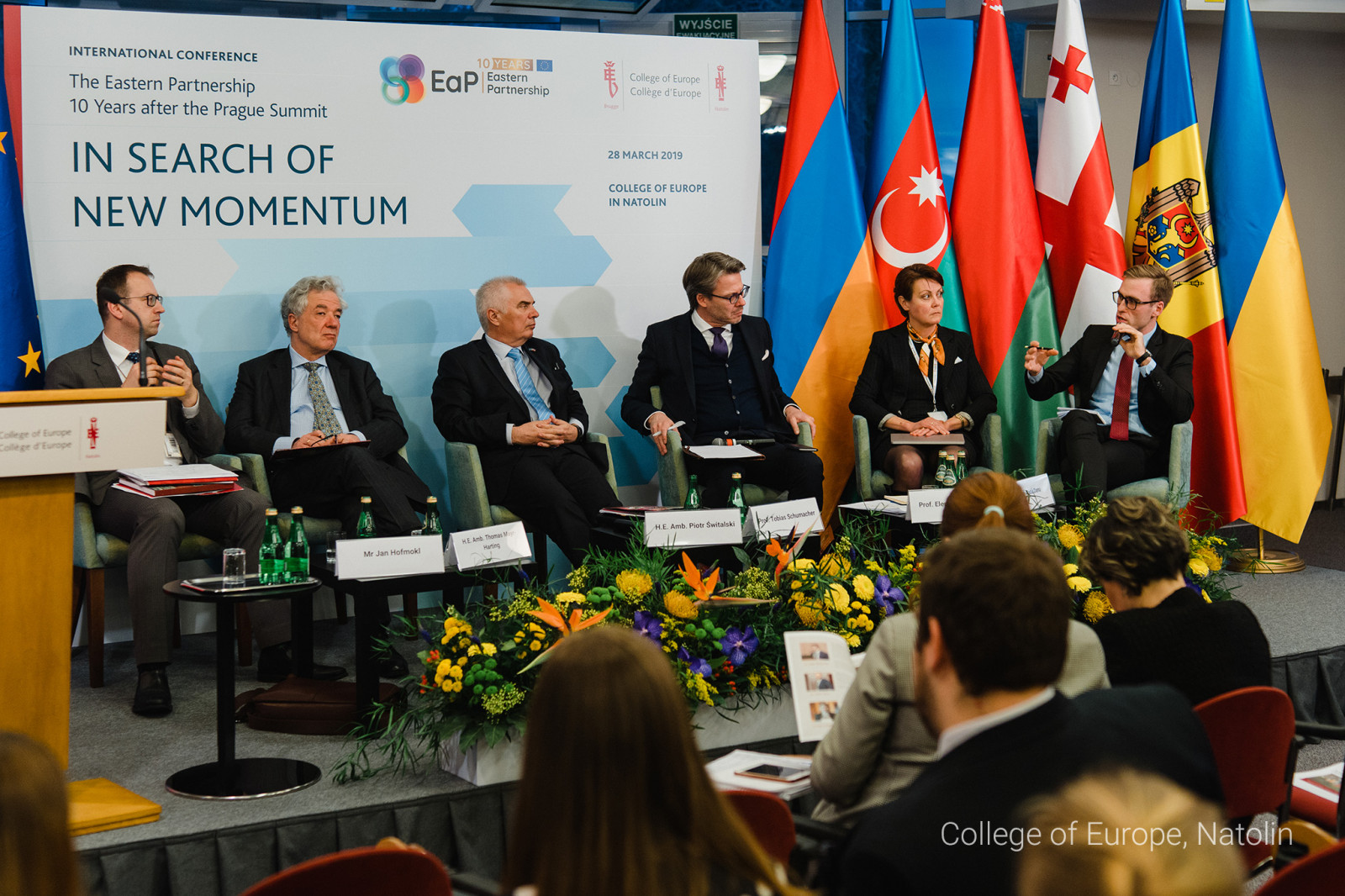 Cette filière permet aux étudiants de mieux comprendre les diverses politiques de l'Union européenne vis-à-vis des pays du voisinage de l'UE (Est, Sud et Sud-Est). Cela donne aux étudiants, par la même occasion, la possibilité de saisir les développements politiques, sociopolitiques, socio-économiques, juridiques, énergétiques et identitaires dans le voisinage de l'UE.