2 years · 4 semesters · 120 ECTS · 2 institutions · 4 study tracks · Joint degree
One joint degree. Two academic traditions. A transatlantic learning experience.
The two-year Master of Arts in Transatlantic Affairs combines study at the College of Europe and The Fletcher School at Tufts University. Across four semesters, you will develop expertise in European and international affairs, experience different academic perspectives and apply your knowledge through a transatlantic internship.
MATA leads to a single, jointly awarded Master of Arts in Transatlantic Affairs worth 120 ECTS. Graduates become alumni of both institutions.
Your programme across the Atlantic
MATA students study at both the College of Europe and The Fletcher School. The first year establishes an academic foundation at the starting institution. The second year normally combines study at the partner institution with a high-level internship.
Students may also choose to spend their entire second year studying at the partner institution.
If you begin at the College of Europe
Develop expertise through one of four tracks in Bruges or Natolin, before continuing your studies at Fletcher and completing an eligible professional internship.
Students beginning at The Fletcher School may also choose to spend their entire second year studying at the College of Europe.
If you begin at The Fletcher School
Build an interdisciplinary foundation at Fletcher, complete a transatlantic internship and continue your academic programme through the appropriate College of Europe track.
View the detailed programme routes:

Choose your academic perspective
- EU International Relations and Diplomacy (Bruges)
For students interested in diplomacy, foreign policy and international cooperation. The track examines relations between states and other global actors, the role of international institutions, and the political, legal and economic forces shaping European and transatlantic affairs. - European Interdisciplinary Studies (Natolin)
For students seeking to understand transatlantic affairs through multiple disciplines and regional perspectives. The track combines politics, history, economics and law, with particular opportunities to explore Central and Eastern Europe, the EU’s wider neighbourhood and Europe’s place in the world. - European Security and Strategy (Natolin)
For students interested in transatlantic security, defence and strategic decision-making. The track examines NATO and European defence, hybrid threats, geo-economics, crisis management and disinformation, drawing on Natolin’s distinctive perspective on Central, Eastern and Northern Europe. - European Political and Governance Studies (Bruges)
For students interested in European politics, institutions and policymaking. The track explores the EU’s political, legal and economic foundations, its system of governance and policy priorities, and the European decision-making processes that shape transatlantic relations.
What will you learn?
MATA equips you to understand transatlantic affairs from European and American perspectives, analyse complex international challenges and communicate practical, evidence-based responses.
Through the programme, you will learn to:
- master the theories and concepts relevant to your chosen study track;
- compare European and American institutions, policymaking processes and political systems;
- interpret contemporary developments in their historical, political, legal and economic contexts;
- analyse complex issues through multiple disciplines and perspectives;
- design independent research and evaluate evidence critically;
- develop clear, feasible and analytically grounded policy responses;
- communicate effectively and work across cultural, institutional and disciplinary boundaries.
[View the complete MATA intended learning outcomes]
A shared transatlantic classroom
All MATA students participate in a year-long shared course on US–EU relations. The first semester establishes a multidisciplinary understanding of transatlantic affairs, while the second moves from analysis to applied work on security and trade.

“MATA enables students to understand both the mechanics of EU–US cooperation and the constantly changing developments that shape it. By studying on two continents with academics and practitioners from the College of Europe and The Fletcher School, students learn to assess transatlantic challenges critically and evaluate them from both European and American perspectives.”
Professor Dimitrios Skiadas
Constantine G. Karamanlis Chair in Hellenic and European Studies
The Fletcher School at Tufts University
From analysis to policy practice
In the second semester, the shared course moves from multidisciplinary analysis to applied work on transatlantic security and trade. Through collaborative policy projects, students examine real-world challenges, assess the interests of different actors and develop recommendations for professional audiences.

“MATA students learn to navigate the complexities of transatlantic policymaking by engaging with real-world policy challenges. They learn how to define core interests, reconcile competing priorities, identify necessary trade-offs, build consensus and develop concrete policy recommendations. This experience prepares them for a career in transatlantic affairs by providing hands-on insight into how policy is developed, negotiated and advanced across borders.”
Professor Benedetta Berti
Visiting Professor, MATA
Secretary General, NATO Parliamentary Assembly
[Meet the MATA faculty]
Learning beyond the formal curriculum
MATA students participate in student-led events and policy discussions across the wider College of Europe community. These activities allow them to explore emerging issues, exchange perspectives with students from other programmes and develop experience in convening and leading policy conversations.

MATA students join their College of Europe peers in Bruges for the student event, “A Conversation on European Defence, Security and Space” on 1 April 2026.
Study at The Fletcher School
At Fletcher, students build breadth across three academic areas:
- International Law and Organizations;
- Diplomacy, History and Politics;
- Economics and International Business.
Students can combine subjects to broaden their knowledge or develop a pathway aligned with their academic interests, thesis topic and professional objectives.
“The flexibility of MATA allowed me to tailor the programme to my academic interests and professional aspirations, while benefiting from a close-knit community on both sides of the Atlantic.”
Anton Sauder, MATA ’25
Consultant, UN Climate Change
Put your knowledge into practice
The MATA internship forms an integral part of the academic experience. Students can work with international or national institutions, private-sector organisations, think tanks or civil-society actors, subject to programme requirements.
The internship provides an opportunity to:
- apply academic knowledge in a professional environment;
- develop practical and cross-cultural skills;
- build a transatlantic network;
- explore a potential career sector;
- refine academic interests and understand how research is used in professional settings.
The internship and thesis remain distinct programme components, and students must respect all host-organisation confidentiality requirements.
[Learn about the high-level internship]
Engage directly with the policy community
During the spring semester, MATA students participate in a Brussels study trip and meet representatives of EU institutions, diplomatic missions and private-sector organisations working on transatlantic policy.
Photographs from recent study trips show students engaging directly with policymakers and practitioners in different institutional settings.
Engage with EU policymakers
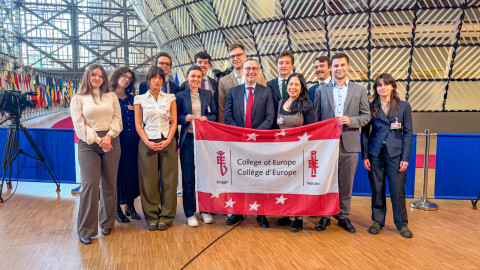
MATA students with Tomas Reyes, then Chair of the Council Working Party on Transatlantic Relations (COTRA), during their 2026 study visit to the Council of the European Union.
Exchange ideas with private-sector practitioners

MATA students engage in a policy discussion during their 2025 visit to the Microsoft Innovation Hub Brussels.
[Discover the Brussels study trip]
Develop your own expertise
The programme culminates in a master’s thesis on a transatlantic topic. Students can use the thesis to deepen their knowledge of a chosen policy field and bring together perspectives developed at both institutions.
Each thesis benefits from academic input from the College of Europe and Fletcher. Combined with the internship and access to both institutions’ professional communities, this allows students to develop a distinctive academic and career profile.
“MATA doubles your networking and learning opportunities. You can develop expertise in your chosen field through a transatlantic internship and a master’s thesis supported from both sides of the Atlantic.” - María Balasch Solá, MATA ’23
[Explore the master’s thesis]
Ready to design your MATA journey?
Explore the tracks, compare starting routes and discover how academic study, professional experience and life on both sides of the Atlantic come together.
[Apply to MATA]