Study Track: EU International Relations and Diplomacy
Understand international affairs. Practise diplomacy. Learn from both sides of the Atlantic.
The EU International Relations and Diplomacy track combines an in-depth understanding of the European Union’s external relations with the breadth of international-affairs study at The Fletcher School.
During the College of Europe component in Bruges, you will examine how the EU acts internationally, how diplomatic negotiations are conducted and how political, legal and economic considerations shape external policy. At Fletcher, you can broaden or deepen your expertise through courses in international law and organisations, diplomacy, politics, history, economics and international business.
Bruges + Fletcher · Negotiation and simulation · Brussels and Geneva study trips · Internship and thesis
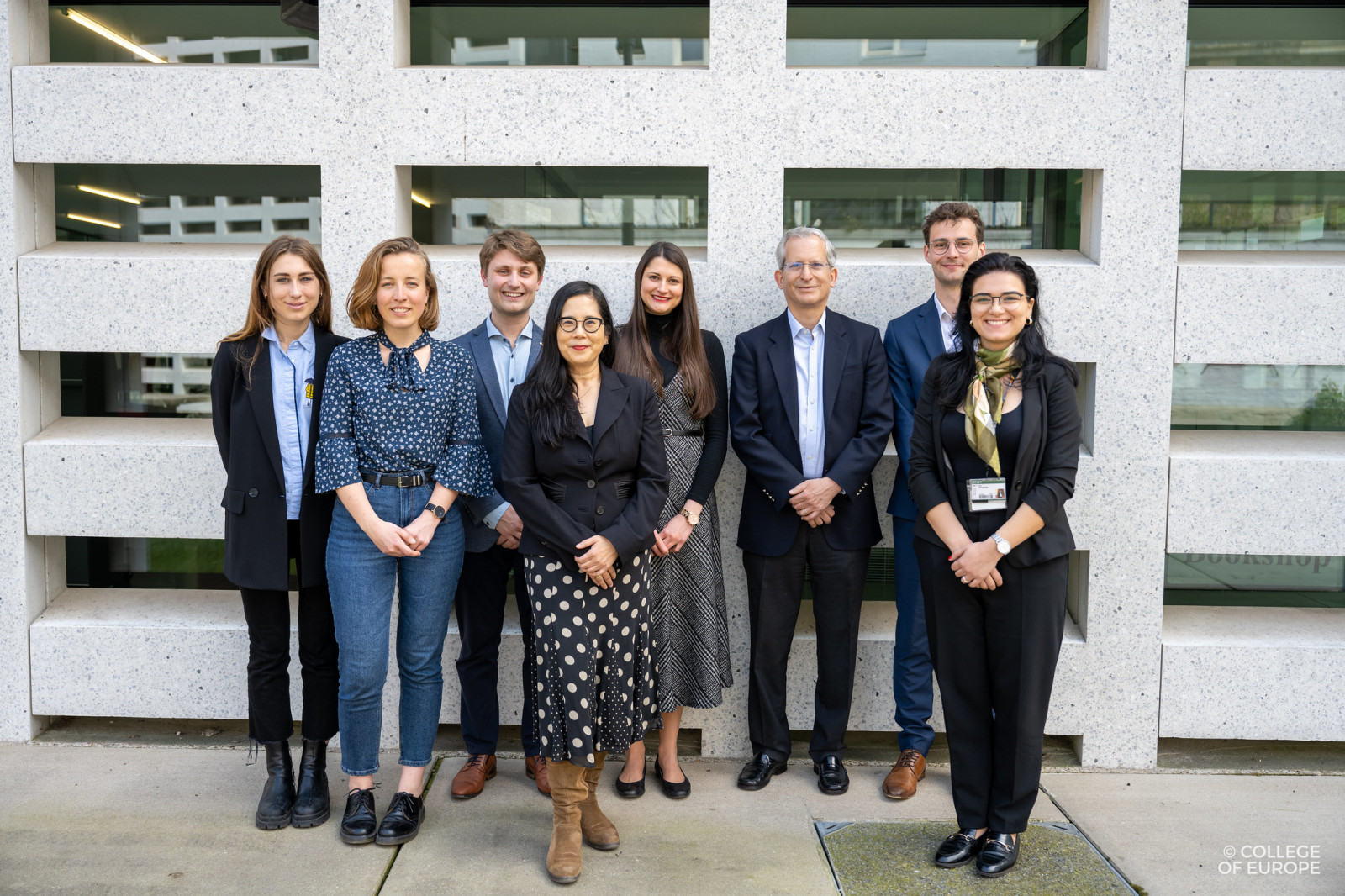
MATA students with former US Ambassador to the EU Anthony Gardner
Why choose this track?
Develop expertise in European and international diplomacy Study the EU as a foreign-policy, security, trade, climate and development actor, while examining its relationships with states, international organisations, businesses and civil society.
Build practical diplomatic skills Develop your ability to analyse negotiations, represent different interests and formulate policy recommendations. An intensive EU crisis-response simulation gives you the opportunity to apply your knowledge under realistic conditions.
Create your own area of specialisation Choose courses from themes including security, sustainable development, economic diplomacy, bilateral and multilateral relations, and professional practice. Current offerings cover topics such as hybrid threats, climate diplomacy, geopolitical risk, intelligence analysis, peace mediation, digital diplomacy and strategic communication.
Complement a European perspective at Fletcher At Fletcher, select courses across international law, diplomacy and politics, and economics and international business. Students may also have an opportunity to take a relevant course elsewhere at Tufts University or at Harvard University, subject to programme rules.
What will you learn?
Through the EU International Relations and Diplomacy track, you will develop the knowledge and skills to:
analyse the EU’s role in international affairs;
examine foreign- and security-policy decision-making;
prepare for and participate in international negotiations;
assess the political, legal and economic dimensions of external relations;
A practitioner perspective on diplomacy and negotiation
The EU International Relations and Diplomacy track combines academic knowledge with the analytical, communication and negotiation skills needed in professional policy environments. Students learn to understand institutional interests, assess political constraints and communicate possible solutions across different national and organisational contexts.
“My experience as a senior diplomat, lobbyist and trade negotiator has shown me that effective transatlantic policymaking requires rigorous analysis, persuasive communication and the ability to navigate changing institutional and political environments. MATA combines strong theoretical foundations with practical skills, preparing students to address complex challenges and contribute constructively to US–EU relations.”
Professor Michael Koplovsky Visiting Professor, MATA Senior Advisor, Kreab International Former senior US diplomat and trade negotiator
Build a strong foundation in EU institutions, foreign and security policy, and international negotiation. You will also begin the joint MATA course on US–EU relations and select courses that reflect your academic interests.
During the semester, you will begin preparing your thesis proposal and internship plans. A research-design seminar supports the development of your thesis, which is supervised with academic input from both institutions.
SKIADAS Dimitris - US-EU Relations in the 21st Century : Multidisciplinary Analysis of Transatlantic Affairs - 5 ECTS
IRD compulsory courses:
LORD Christopher - EU Institutions and Decision Making - 1 ECTS
JUNCOS Ana E. - EU Foreign and Security Policy - 3.5 ECTS
MARCHI Francesco - International and EU Negotiation Analysis - 3.5 ECTS
Elective courses:
In addition, students choose 2 of the following courses:
WOLFF Sarah - External Dimensions of EU Internal Policies: Decentring Migration, Gender and Religion - 3.5 ECTS OR SCHUNZ Simon - External Dimensions of EU Internal Policies: Climate Change, Energy Policy, and the Environment - 3.5 ECTS
GSTÖHL Sieglinde - EU Trade Policy and Emerging Economic Statecraft - 3.5 ECTS
KIONKA Riina - The Craft and Practice of EU Diplomacy - 3.5 ECTS
WOUTERS Jan - Legal Aspects of the EU’s External Relations - 3.5 ECTS
Voluntary seminar in research design (no ECTS)
GSTÖHL Sieglinde & SCHUNZ Simon - Research Design in EU External Action Studies
Semester 2: From analysis to practice
Apply your knowledge through the practice-oriented MATA course and an intensive simulation of an EU response to an international crisis.
Choose four electives across thematic areas including security, sustainable development, diplomacy and professional skills. You will also continue developing your thesis and preparing for your internship.
BERTI Benedetta & KOPLOVSKY Michael - US-EU Relations in the 21st Century: Security and Trade in Practice – 5 ECTS
IRD compulsory simulation game:
RIBO LABASTIDA Alejandro & WEILER Quentin - Simulation Game: EU International Crisis Response – 3 ECTS
Elective courses:
Students choose to follow any 4 optional courses offered by the Department (4.5 ECTS and 25h each). They are strongly encouraged to take these courses from at least 2 different thematic clusters.
Security, Justice and Values
CADIER David - Les politiques étrangères nationales et l’action extérieure de l’Union européenne - 4.5 ECTS
MORENO-LAX Violeta & PERKOWSKI Nina - EU Borders, Asylum and Migration Policies: A Critical Perspective - 4.5 ECTS
SMITH Hanna - Hybrid Threats to European Security: Challenges and Counteraction- 4.5 ECTS
TARDY Thierry - L’Europe de la sécurité et de la défense (PSCD, capacités, cultures stratégiques) - 4.5 ECTS
YOUNGS Richard - EU Democracy Promotion and Human Rights Policy - 4.5 ECTS
Foreign Economic Relations and Sustainable Development
GOLDTHAU Andreas - EU External Energy Policy - 4.5 ECTS
MACKIE James - The EU and International Development - 4.5 ECTS
PERIDY Nicolas - Négociations et politiques commerciales de l’UE : outils et études de cas - 4.5 ECTS
SCHUNZ Simon - The EU and the Global Politics of Climate Change and the Environment - 4.5 ECTS
SOTILOTTA Cecilia E. - (Geo)Political Risk Analysis from a European Perspective - 4.5 ECTS
Bi- and Multilateral Diplomacy
ALLWOOD Gil & GUERRINA Roberta - Inclusion in EU External Action: Gender and Intersectionality at a Time of Geopolitics - 4.5 ECTS
DEMARAIS Agathe & EKMAN Alice - Rivalités entre grandes puissances : l'Europe et les nouveaux rapports de force géopolitiques et économiques - 4.5 ECT
FRÖHLICH Stefan - Transatlantic Fracture: The Erosion of US-EU Relations - 4.5 ECTS
GSTÖHL Sieglinde & ZEIDAN Sami - Speaking with one Voice? The EU's External Representation - 4.5 ECTS
MICHALSKI Anna - The Evolving Relations between the EU and China: Partnership and Competition in a Changing World Order - 4.5 ECTS
PHINNEMORE David - EU Enlargement … and UK Withdrawal - 4.5 ECTS
Specific Professional Skills
ARCOS Ruben - European Intelligence Analysis and Production in Practice - 4.5 ECTS
BANIM Guy & HERRBERG Antje - The EU and Peace Mediation - 4.5 ECTS
COLOMINA SALO Carme - Rethinking Strategic EU Communication in Times of Information Disorder and AI - 4.5 ECTS
KOULAIMAH Andrea - Le rôle de l’aide humanitaire dans l'action extérieure globale de l'UE: cadre et pratique - 4.5 ECTS
MARCOUX Nicolas - Gestion de projets et d’intervention dans l’action extérieure globale de l’Union européenne - 4.5 ECTS
TELEANU Sorina - Digital Diplomacy and the European Union: Global Governance, Geopolitics and Diplomatic Practice - 4.5 ECTS
Students will continue to work on their thesis in transatlantic affairs and prepare their internship. They may follow any of the voluntary, non-assessed compact seminars (8h) offered by the IRD Department. These seminars may be offered either in the first or second semester, depending on the professors’ availability.
Compact seminars
APTEL Cécile - L’Union européenne et la justice internationale - 8 h.
BELLOSI SabrinaPublic Diplomacy and Strategic Communication as EU Foreign Policy Tools - 8 h.
COLLIER Zoë - Writing and Presenting Impactful Policy Briefings in a Political Environment - 8 h.
DELPHIN Hervé - Prospective et planification stratégiques dans le cadre de la politique étrangère de l’UE - 8 h.
HARDING Gareth - Effectively Working with EU Media - 8 h.
JESLINKOVA Eva - Introduction au protocole : protocole diplomatique et européen - 8 h.
MAYR-HARTING Thomas - Challenges Facing European Diplomats: Practical Insights - 8 h.
MUTAMBA Annie - L’action extérieure de l’UE : Lobbying et stratégies d’influence - 8 h.
TON Ron - Leadership in Foreign Policy: Strategic Thinking and Analysis - 8 h.
VENNERI Giulio - Advising on EU External Affairs and Diplomacy - 8 h.
A shared classroom across the Atlantic
All MATA students participate in a year-long joint course on US–EU relations. The first semester establishes a multidisciplinary understanding of transatlantic affairs. The second moves from analysis to applied work on security and trade.
This common course connects students across MATA’s institutions and tracks while giving IRD students a transatlantic framework for their European specialisation.
Experience diplomacy beyond the classroom
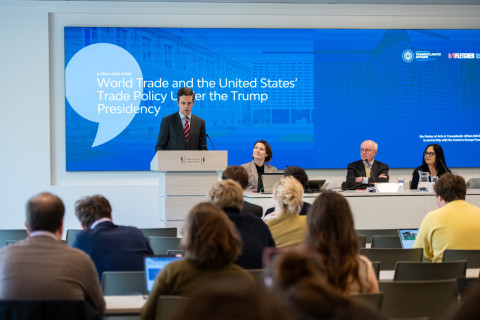
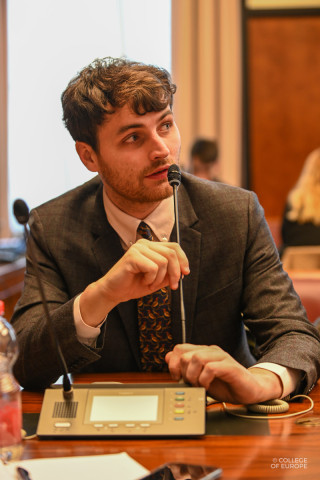
Nicolas Bobadilla, current MATA student representative, contributes to a high-level discussion on transatlantic trade alongside former Belgian Ambassador to the United States Dirk Wouters. April 2026
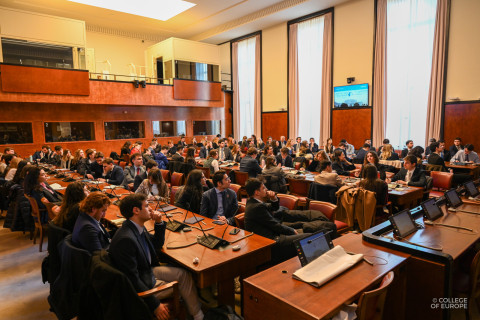
Through conferences, practitioner-led discussions, simulations and study visits, MATA-IRD students engage directly with diplomats, policymakers and experts working on European and transatlantic affairs. These experiences allow students to test their ideas, develop their communication skills and connect academic study with diplomatic practice.
Brussels
During the MATA study trip, engage with professionals working on transatlantic relations and connect classroom subjects with current policy debates.
Geneva
Through the IRD study trip, explore multilateral diplomacy in one of the world’s most important centres for international organisations, negotiation and global governance.
IRD study trip to Geneva
Crisis-response simulation
Work with classmates to analyse a developing international crisis, negotiate institutional and political priorities, and formulate a coordinated response. The simulation is an assessed component of the second-semester curriculum.
Continue your studies at Fletcher
At Fletcher, shape your curriculum through courses from three academic areas:
International Law and Organizations;
Diplomacy, History and Politics;
Economics and International Business.
Students select four courses during a Fletcher semester and may be able to substitute one with a relevant course from Tufts University or Harvard University.
Choose your second-year route:
Route 1: Fletchter > Internship
Route 2: Internship > Fletcher
Route 3: Full year at Fletcher
S3 Coursework
S4 Internship
Internship: YES
S3 Internship
S4 Coursework
Internship: YES
S3 Coursework
S4 Coursework
Internship: NO
View route details
View route details
View route details
Connect your studies with professional experience
Complete a high-level internship related to transatlantic affairs, normally lasting three to four months. Students beginning at the College of Europe are encouraged to undertake their internship in the United States.
The internship gives you the opportunity to apply your knowledge, explore a professional field and strengthen your international network.
Alumni profile
From a MATA internship to a European public-affairs career
After completing his MATA internship at the Council of the European Union, Adam joined the Arcturus Group as a public affairs consultant. He subsequently worked in the office of a Member of the European Parliament and at the French Ministry of the Interior before returning to Brussels to continue his career in public affairs.
“MATA’s IRD track gave me a strong academic grounding in EU policy and diplomacy, together with valuable practical experience. During my MATA internship at the Council of the European Union, I supported preparations for European Council meetings and worked on EU–UK relations. The knowledge and skills I developed through the programme proved invaluable in that role and have continued to support me across EU institutions, national government and the private sector.”
Adam Beunardeau-Pammen, MATA ’24
Develop your own area of expertise
Your master’s thesis allows you to investigate a transatlantic subject in depth. The thesis is developed with supervision connected to both the College of Europe and Fletcher, allowing you to bring European and American academic perspectives to your research.
Where can this track take you?
The combination of academic knowledge, negotiation practice, policy writing, international exposure and professional experience can support careers in:
diplomacy and foreign ministries;
EU and international institutions;
security and foreign-policy analysis;
trade, climate and economic diplomacy;
think tanks and policy research;
consulting and political-risk analysis;
strategic communication and public affairs;
civil society, development and humanitarian organisations.
Career paths vary according to each student’s academic interests, prior experience, internship choices and professional objectives. The examples above illustrate sectors and functions for which the track develops relevant knowledge and skills.
The College of Europe has successfully concluded the sixth edition of TellUs, its flagship extracurricular initiative developed in partnership with the European Commission’s Directorate-General for...