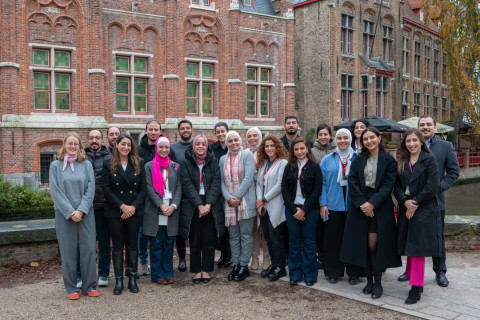
See Europe and transatlantic affairs from a wider perspective
The European Interdisciplinary Studies track at Natolin brings together politics, international relations, law, economics, history and regional studies. It is designed for students who want to understand complex transatlantic challenges in their broader European, historical and geopolitical contexts.
During your first year at the College of Europe, you will build interdisciplinary foundations and explore Europe’s relations with its neighbours and the wider world. At The Fletcher School, you can complement this perspective through coursework in international law, diplomacy and politics, economics and international business.
Natolin + Fletcher · Interdisciplinary foundations · Two specialist majors · Regional study trips · Internship and thesis
[Explore the two majors]
[View courses and ECTS]
Why choose European Interdisciplinary Studies?
Understand complex issues across disciplines
Contemporary transatlantic challenges cannot be understood through politics, law, economics or history alone. MATA-EIS teaches you to bring these perspectives together, identify connections and produce more complete analyses of complex events and policy choices.
Place current developments in context
Examine how history, geography, institutions, identities and regional dynamics continue to shape contemporary Europe, its transatlantic relationships and its engagement with neighbouring regions.
Develop a distinctive regional perspective
Study in Natolin and gain particular insight into Central and Eastern Europe, the EU’s eastern and southern neighbourhoods, enlargement and Europe’s changing geopolitical environment.
Create your own academic pathway
Begin with a broad interdisciplinary foundation before choosing a major and specialist courses aligned with your interests. The curriculum allows you to explore subjects ranging from trade, diplomacy and climate governance to migration, human rights, neighbourhood policy and digital politics.
Add an American and international perspective
Continue your studies at Fletcher, complete a transatlantic internship and develop a thesis drawing on perspectives from both institutions.
What will you learn?
The track combines the programme-wide MATA learning outcomes with an interdisciplinary understanding of Europe, its neighbouring regions and its international relationships.
Bring together different disciplines
Use concepts and methods from politics, international relations, law, economics, history and regional studies to examine a common transatlantic question.
Understand Europe in its regional context
Analyse European integration alongside the historical, political and social dynamics of Central and Eastern Europe and the EU’s wider neighbourhood.
Examine the EU’s global role
Assess how the EU operates as an international actor through diplomacy, trade, development, migration, climate policy, external relations and security cooperation.
Connect historical developments with current choices
Understand how borders, identities, conflicts, institutions and past relationships influence contemporary political debates and policy decisions.
Compare perspectives and interpret complexity
Evaluate questions through European, American and regional perspectives while remaining open to different interpretations, disciplines and cultural contexts.
Research and communicate practical responses
Develop evidence-based analysis, design independent research and communicate clear recommendations to academic and professional audiences.
[View the full MATA intended learning outcomes]
Your first year at Natolin
Semester 1: Build interdisciplinary foundations
Begin with introductory courses in political science, international relations, law, economics, European integration, interdisciplinarity and European history. These short courses create a shared foundation for students entering MATA from different academic backgrounds.
You will then deepen your knowledge through assessed courses addressing Central and Eastern European history and selected political, legal, economic or interdisciplinary questions. The first-semester study trip provides an opportunity to examine regional developments and policies in context.
[View Semester 1 courses and ECTS]
Compulsory MATA courses
Introductory Courses (no ECTS)
- Sebastian Steingass & Amel Hammami, Introduction to Political Science, 10h
- Tobias Schumacher, Introduction to International Relations, 10h
- Peter Van Elsuwege, Introduction to Law, 10h
- Barbara Bobrowicz, Introduction to Economics, 10h
- Wolfgang Wessels, Introduction to Theories and Strategies of European Integration, 10h
- Rick Szostak, Introduction to Interdisciplinarity and Transdisciplinarity, 10h
- Edward Hunter Christie, Elementary Foundations in Economics and Econometrics, 10h
- Richard Butterwick-Pawlikowski, History of European Civilization, 10h
Compulsory EIS course
Assessed core courses:
Pluridisciplinary Option
Christopher Lord, EU Institutions and Decision-making, 4 ECTS
Peter Van Elsuwege, The EU Legal Order: Rights, Norms and Values, 4 ECTS
Wolfgang Wessels, EU Economic Governance, 4 ECTS
Interdisciplinary Option
James Henderson, Energy in a Globalised World: Economics, Politics and Policies, 4 ECTS
Jean-Pierre Cassarino, International Cooperation and the Governance of Migration, 4 ECTS
Erwan Lannon, The EU Enlargement and Neighbourhood Strategies: a Geo-Legal Approach, 4 ECTS
Angelo Martelli, Political Economy of Europe in a Changing World Order, 4 ECTS
Study Trip: Coordinator: Ewa Ośniecka-Tamecka; Professors: Georges Mink, Andriy Tyushka, Thomas Mayr-Harting, Marek Cichocki, Sławomir Dębski & Pascaline Winand, Study Trip Modules, 2 ECTS
Non-assessed contextual courses (up to 2 may be selected, no ECTS):
Philippe Portier, La religion dans l’Europe contemporaine
Anneli Kimber Lindwall, Strategic Communication in a Digital Age
Ayman Mhanna, Grands enjeux de la liberté de la presse
Patrycja Sasnal, Climate Induced Migration
Rémi Brague, Orientalisme
Ewa Krukowska, Media and Climate: Communicating the Energy Transition
Marek Aleksander Cichocki and Slawomir Debski, Cold War Strategies from the Central Eastern Europe Perspective
Non-assessed seminar (no ECTS):
Sebastian Steingass (coordinator), Barbara Bobrowicz, Natalia Chaban, Theofanis Exadaktylos, Kerry Longhurst, Georges Mink, Jason Rozumalski, Rick Szostak, Peter Van Elsuwege, Matia Vannoni, Pascaline Winand, Research Strategies and Tools
Non-assessed masterclass (no ECTS):
Simulation game (no ECTS):
Richard Butterwick-Pawlikowsk, The Paris Peace Conference of 1919-20
Vicky Marissen, EU Decision-making and Interest Representation in Practice / Le processus décisionnel de l'Union européenne et la représentation d'intérêts
Semester 2: Develop your specialisation
Choose one of two majors and select four specialist courses within it. You will also continue the joint MATA course, participate in a study trip and develop your thesis proposal and internship plans.
[View Semester 2 courses and ECTS]
Compulsory MATA courses:
Study Trip: Coordinator: Ewa Ośniecka-Tamecka; Professors: Georges Mink, Andriy Tyushka, Thomas Mayr-Harting, Marek Cichocki, Sławomir Dębski & Pascaline Winand, Study Trip Modules, 2 ECTS
Voluntary courses for all majors: Cooperation with external partners
Elzbieta Mikos-Skuza, Introduction to International Humanitarian Law within the framework of a seminar organized with the International Committee of the Red Cross - open to external participants
Workshops in history organized in cooperation with the Max Weber programme of the European University Institute
Choose your major

[View courses in The EU and the World ] | [View courses in Wider Europe and its Neighbours] |
Specialist courses for the Major, The EU and the World: Karen E Smith, The International Relations of the EU, 4 ECTS Steven Blockmans, The Legal Dimension of EU External Relations, 4 ECTS - Rupert Schlegelmilch, EU Trade Policy from Rules based Trade to Trade Wars, 4 ECTS
- Thomas Mayr-Harting, The European Union and Bi- and Multilateral Diplomacy, 4 ECTS
Youssef Nassef, International Climate Governance: Foresight and Transformative Change, 4 ECTS Pascaline Winand, Comparative Regionalism, 4 ECTS Patrycja Sasnal, Human Rights in International Politics, 4 ECTS Jillian York, Politics in the Digital Age: Power, Platforms, and Participation, 4 ECTS Stefan Fröhlich, After Liberal Hegemony - Transatlantic Relations at a Crossroad, 4 ECTS Jean-Pierre Cabestan, China and the World, 4 ECTS - Sandra Lavenex & Florian Trauner, EU Asylum and Migration Policy in Global Context , 4 ECTS
Maurizio Carbone, The European Union, the Global South and the Politics of International Development, 4 ECTS Thierry Tardy, NATO and European Defense Policy, 4 ECTS
Compact seminars for the Major, The EU and the World (no ECTS): Paul Watkinson, The Central Role of International Cooperation in Strengthening Climate Action Shada Islam, The EU and the Indo-Pacific - Véronique Dimier, L'Etat post-colonial en Afrique à l'épreuve des politiques européennes de développement
Gian Luca Gardini The International Relations of Latin America and its Interaction with the EU Andrea Renda (tbc) Regulation of Emerging Technologies
Simulation games for the Major, The EU and the World (no ECTS): Richard Butterwick-Pawlikowski, Creating a System of European Security: The Congress of Vienna 1814-15 Lukas Andriukaitis, Disinformation in Diplomacy
| Specialist courses for the Major, The EU in the Wider Europe and its Neighbours: Tobias Schumacher, Whither Neighbourhood? The EU, Eastern Europe, and the Southern Mediterranean in Times of Peace and War, 4 ECTS Adam Łazowski, Enlargement Policy of the European Union, 4 ECTS Jean-Pierre Cassarino & Daria Davitti, Contested Migration Governance: Policies, Norms, and Human Rights at the Border, 4 ECTS Aron Buzogany, EU Energy Governance in the EU's Neighbourhood, 4 ECTS - Christophe Hillion, The EU’s Relation(s) with a Wider Europe – The Legal Dimension, 4 ECTS
Joshua Castellino & Kathleen Cavanaugh, Minority Issues, Nationalism and Identity Politics in the EU’s Neighbourhood, 4 ECTS Andriy Tyushka, The EU, Russia and the EU’s Eastern Neighbourhood: Power, Performance, and Perceptions, 4 ECTS
Compact seminars for the Major, The EU in the Wider Europe and its Neighbours (no ECTS): Simulation game for the Major, The EU in the Wider Europe and its Neighbours (no ECTS): Richard Butterwick-Pawlikowski, Creating a System of European Security: The Congress of Vienna 1814-15 Luca Franza, Energy and Climate in the Neighbourhood
|
A shared MATA classroom
Examine transatlantic affairs with students across both institutions
All first-year MATA students participate in the shared course on US–EU relations. The first-semester course provides multidisciplinary analysis of transatlantic affairs, while the second-semester component moves toward applied work on security and trade.
This course gives MATA-EIS students a common transatlantic foundation while allowing them to bring Natolin’s interdisciplinary and regional perspective into discussions with the wider MATA cohort.
Study beyond the classroom
Experience regions, borders and policies in context
Natolin study trips allow students to examine how history, identity, institutions and public policy interact in particular places. Through discussions with officials, experts and local actors, students connect academic concepts with developments on the ground.
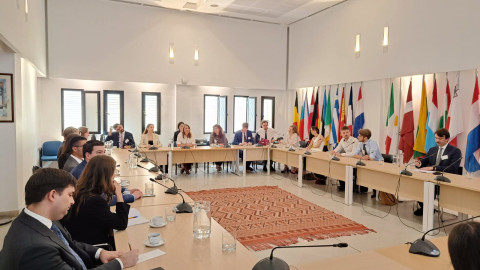
A MATA-EIS student joins European Interdisciplinary Studies peers for a roundtable discussion during the 2025–2026 study trip to Tunis.
Fletcher and the second-year routes
Continue your academic journey at Fletcher
At Fletcher, students can complement their Natolin foundation through coursework in:
- International Law and Organizations;
- Diplomacy, History and Politics;
- Economics and International Business.
Route 1: Fletchter > Internship | Route 2: Internship > Fletcher | Route 3: Full year at Fletcher |
- S3 Coursework
- S4 Internship
Internship: YES | - S3 Internship
- S4 Coursework
Internship: YES | - S3 Coursework
- S4 Coursework
Internship: NO |
| View route details | View route details | View route details |
Alumni profile
From transatlantic policy research to the World Bank and European Commission
During MATA, Pau completed his internship at the Center for Strategic and International Studies in Washington, DC. He later worked with Baltic countries at the World Bank and  completed a Blue Book traineeship at the European Commission, where he contributed to Europe’s Technology Sovereignty Package.
His trajectory demonstrates how MATA-EIS can connect interdisciplinary study, regional expertise and transatlantic professional experience with work in international and European institutions.
“MATA-EIS gave me an interdisciplinary perspective that has been invaluable throughout my career. The Natolin study trip to the Baltic region directly supported my early work with Baltic countries at the World Bank. The programme’s focus on US–EU relations, technology, security and industrial policy also prepared me to contribute to Europe’s Technology Sovereignty Package during my Blue Book traineeship.” Pau Alvarez Aragones, MATA ’24, Policy Officer, DG CNECT, European Commission
MATA-EIS: Where can this track take you?
The European Interdisciplinary Studies track prepares you to approach complex policy questions from multiple disciplinary, historical and regional perspectives. Its combination of academic breadth, regional expertise, field-based learning and professional experience can support careers in:
- EU and international institutions;
- international development organisations;
- diplomacy and national government;
- enlargement and neighbourhood policy;
- think tanks and policy research;
- regional and geopolitical analysis;
- migration, climate and energy policy;
- human rights and civil society;
- international cooperation and development;
- consulting and political-risk analysis;
- academic research.
Through study at Natolin and Fletcher, regional study trips, a high-level internship and a transatlantic thesis, students learn to connect politics, economics, law, history and regional studies when analysing challenges that do not fit within a single policy area.
Career paths vary according to each student’s academic interests, prior experience, internship choices and professional objectives. The examples above illustrate sectors and functions for which the track develops relevant knowledge and skills.
[Apply to MATA]